Back to table of contents Challenge Problems

Challenge Problems

88.

Vector B→ is 5.0 cm long and vector A→ is 4.0 cm long. Find the angle between these two vectors when |A→ +B→ |=3.0cm .

89.

What is the component of the force vector G→ =(3.0i^ +4.0j^ +10.0k^ )N along the force vector H→ =(1.0i^ +4.0j^ )N ?

90.

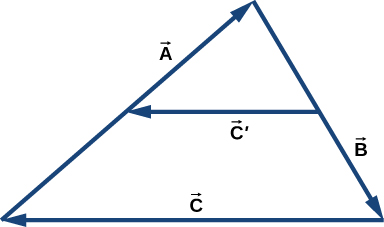
The following figure shows a triangle formed by the three vectors A→ , B→ , and C→ . If vector C→ ′ is drawn between the midpoints of vectors A→ and B→ , show that C→ ′=C→ /2 .

Vectors A, B and C form a triangle. Vector A points up and right, vector B starts at the head of A and points down and right, and vector C starts at the head of B, ends at the tail of A and points to the left. Vector C prime is parallel to vector C and connects the midpoints of vectors A and B.
91.

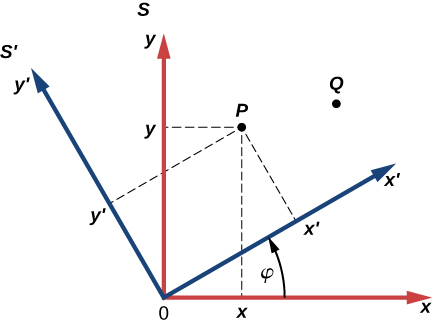
Distances between points in a plane do not change when a coordinate system is rotated. In other words, the magnitude of a vector is invariant under rotations of the coordinate system. Suppose a coordinate system S is rotated about its origin by angle φ to become a new coordinate system S′ , as shown in the following figure. A point in a plane has coordinates (x, y) in S and coordinates (x′,y′ ) in S′ .

(a) Show that, during the transformation of rotation, the coordinates in S′ are expressed in terms of the coordinates in S by the following relations:

{ x ′ = x cos φ + y sin φ y ′ = − x sin φ + y cos φ .

(b) Show that the distance of point P to the origin is invariant under rotations of the coordinate system. Here, you have to show that

x 2 + y 2 = x ′ 2 + y ′ 2 .

(c) Show that the distance between points P and Q is invariant under rotations of the coordinate system. Here, you have to show that
( x P − x Q ) 2 + ( y P − y Q ) 2 = ( x ′ P − x ′ Q ) 2 + ( y ′ P − y ′ Q ) 2 .
Two coordinate systems are shown. The x y coordinate system S, in red, has positive x to to the right and positive y up. The x prime y prime coordinate system S prime, in blue, shares the same origin as S but is rotated relative to S counterclockwise an angle phi. Two points, P and Q are shown. Point P’s x coordinate in frame S is shown as a dashed line from P to the x axis, drawn parallel to the y axis. Point P’s y coordinate in frame S is shown as a dashed line from P to the y axis, drawn parallel to the x axis. Point P’s x prime coordinate in frame S prime is shown as a dashed line from P to the x prime axis, drawn parallel to the y prime axis. Point P’s y prime coordinate in frame S prime is shown as a dashed line from P to the y prime axis, drawn parallel to the x prime axis.
Back to table of contents