Back to table of contents Chapter 2

Chapter 2

Check Your Understanding

2.1

a. not equal because they are orthogonal; b. not equal because they have different magnitudes; c. not equal because they have different magnitudes and directions; d. not equal because they are antiparallel; e. equal.

2.2

16 m; D→ =−16mu^

2.3

G = 28.2 cm, θG=291°

2.4

D→ =(−5.0i^ −3.0j^ )cm ; the fly moved 5.0 cm to the left and 3.0 cm down from its landing site.

2.5

5.83 cm, 211°

2.6

D → = ( −20 m ) i ^

2.7

35.2 m/s = 126.7 km/h

2.8

G → = ( 10.25 i ^ − 26.22 j ^ ) cm

2.9

D = 55.7 N; direction 65.7° north of east

2.10

v^ =0.8i^ +0.6j^ , 36.87° north of east

2.11

A→ ·B→ =−57.3 , F→ ·C→ =27.8

2.13

131.9 °

2.14

W1=1.5J , W2=0.3J

2.15

A→ ×B→ =−40.1k^ or, equivalently, |A→ ×B→ |=40.1 , and the direction is into the page; C→ ×F→ =+157.6k^ or, equivalently, |C→ ×F→ |=157.6 , and the direction is out of the page.

2.16

a. −2k^ , b. 2, c. 153.4° , d. 135°

Conceptual Questions

1.

scalar

3.

answers may vary

5.

parallel, sum of magnitudes, antiparallel, zero

7.

no, yes

9.

zero, yes

11.

no

13.

equal, equal, the same

15.

a unit vector of the x-axis

17.

They are equal.

19.

yes

21.

a. C=A→ ·B→ , b. C→ =A→ ×B→ or C→ =A→ −B→ , c. C→ =A→ ×B→ , d. C→ =AB→ , e. C→ +2A→ =B→ , f. C→ =A→ ×B→ , g. left side is a scalar and right side is a vector, h. C→ =2A→ ×B→ , i. C→ =A→ /B , j. C→ =A→ /B

23.

They are orthogonal.

Problems

25.

h→ =−49mu^ , 49 m

27.

30.8 m, 35.7° west of north (equivalently, 54.2° north of west or 125.7° from east)

29.

134 km, 80°

31.

7.34 km, 63.5° south of east

33.

3.8 km east, 3.2 km north, 7.0 km

35.

14.3 km, 65°

37.

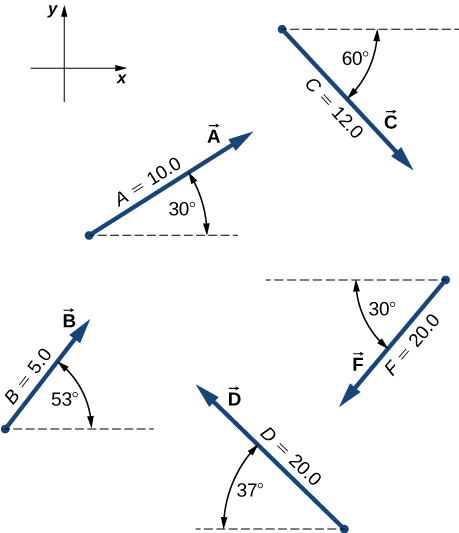
a. A→ =+8.66i^ +5.00j^ , b. B→ =+3.01i^ +3.99j^ , c. C→ =+6.00i^ −10.39j^ , d. D→ =−15.97i^ +12.04j^ , f. F→ =−17.32i^ −10.00j^

The figure shows an x-y axis in the upper left corner followed by 5 unique vectors drawn on the x-y plane. Vector A has a magnitude of 10.0 and points 30 degrees above the x-axis. Vector B has a magnitude of 5.0 and points 53 degrees above the x-axis. Vector C has a magnitude of 12.0 and points 60 degrees below the x-axis. Vector D has a magnitude of 20.0 and points 37 degrees above the negative x-axis. Vector F has a magnitude of 20.0 and points 30 degrees below the negative x-axis.
39.

a. 1.94 km, 7.24 km; b. proof

41.

3.8 km east, 3.2 km north, 2.0 km, D→ =(3.8i^ +3.2j^ )km

43.

P1(2.165m,1.250m) , P2(−1.900m,3.290m) , 4.55 m

45.

8.60 m, A(25 m,0.647π) , B(32 m,0.75π)

47.

a. A→ +B→ =−4i^ −6j^ , |A→ +B→ |=7.211,θ=236° ; b. A→ −B→ =–2i^ +2j^ , |A→ −B→ |=22 ,θ=135°

49.

a. C→ =(5.0i^ −1.0j^ −3.0k^ )m,C=5.92m ;
b. D→ =(4.0i^ −11.0j^ +15.0k^ )m,D=19.03m

51.

D→ =(3.3i^ −6.6j^ )km , i^ is to the east, 7.34 km, −63.5°

53.

a. R→ =−1.35i^ −22.04j^ , b. R→ =−17.98i^ +0.89j^

55.

D→ =(200i^ +300j^ )yd , D = 360.5 yd, 56.3° north of east; The numerical answers would stay the same but the physical unit would be meters. The physical meaning and distances would be about the same because 1 yd is comparable with 1 m.

57.

R → = ( −3 i ^ − 16 j ^ ) m

59.

E→ =EE^ , Ex=+178.9V/m , Ey=−357.8V/m , Ez=0.0V/m , θE=−tan−1(2)

61.

a. –34.290 R→ B=(–12.278i^ +7.089j^ +2.500k^ )km , R→ D=(−34.290i^ +3.000k^ )km ; b. |R→ B−R→ D|=23.131km

63.

a. 0, b. 0, c. –0.866, d. –17.32

65.

θ i = 64.12 ° , θ j = 150.79 ° , θ k = 77.39 °

67.

a. −120k^ , b. 0k^ , c. 94k^ , d. –240k^ , e. 4.0k^ , f. −3.0k^ , g. 15k^ , h. 0

69.

a. 0, b. 0, c. 20,000k^

Additional Problems

71.

a. 18.4 km and 26.2 km, b. 31.5 km and 5.56 km

73.

a. (r,π−φ ) , b. (2r,φ+2π) , c. (3r,−φ)

75.

d PM = 6.2 nmi = 11.4 km , d NP = 7.2 nmi = 13.3 km

77.

proof

79.

a. 10.00 m, b. 5πm , c. 0

81.

22.2 km/h, 35.8° south of west

83.

270 m, 4.2° north of west

85.

B→ =−4.0i^ +3.0j^ or B→ =4.0i^ −3.0j^

87.

proof

Challenge Problems

89.

G H = 19 N / 17 ≈ 4.6 N

91.

proof

Back to table of contents